Inclusion Isn't a Building: Why the Future of Education Must Be Integrated
There is a growing conversation taking place in education about how best to support neurodiverse learners. It is an important discussion, and one that deserves thoughtful leadership rather than fashionable solutions.
Recently, we have seen schools announcing separate specialist provisions for pupils with Additional Learning Needs, positioning this as an exciting new direction and a reflection of changing demand. While every school must make decisions that suit its own circumstances, I believe we should be asking a much bigger question:
Are we preparing young people for the world they are entering, or are we creating environments that no longer exist beyond the school gates?
At St David's College, our answer has always been clear.
We don't believe neurodiversity belongs on the outskirts of education, in a different building, under a different name or operating under a different structure. We believe it belongs at the heart of a learning community, where differences are understood, valued and celebrated alongside academic ambition.
Because that's exactly how the real world works.
Businesses, universities, research laboratories, creative industries and sports organisations do not separate people according to how they think or learn. The strongest teams are built on different perspectives, different strengths and different ways of solving problems. Innovation happens because people think differently, not despite it.
If our responsibility is to prepare young people for life, then education must reflect that reality.
There is a growing temptation within the sector to chase market trends or respond to financial pressures by creating new products that appear to meet demand. Separate specialist provision may make commercial sense for some institutions, but we should be careful not to mistake structural separation for educational progress.
True inclusion is not achieved by creating another part of a school and treating it differently.
It is achieved by creating one community where every learner can thrive.
For over sixty years, St David's College has specialised in educating young people with dyslexia, ADHD, dyscalculia and a wide range of learning differences alongside their peers. Our expertise has never been about creating dependence or lowering expectations. It has always been about developing independence, resilience and self-belief.
So, here’s the reality: students with learning differences can achieve the A* Grades, or C Grades other than none. And yes, many become doctors, lawyers, entrepreneurs and engineers – among countless other paths. But you probably knew that already, right?
Our students leave us knowing how to advocate for themselves, collaborate with others and contribute confidently to environments where people think differently. Those are the skills employers increasingly value and society increasingly need.
At St David's, we could talk endlessly about league tables or being the most exclusive or the most elite. But education is not a competition where one child succeeds only because another is separated.
We believe there is a better ambition.
An ambition that doesn't rely on hierarchy or comparison, but on helping every young person discover their strengths and use them for the benefit of others.
To be good. Genuinely, deeply, right-down-to-the-bone good.
Because the leaders of tomorrow will need far more than examination results. They will need empathy where there is division, creativity where there is complexity and confidence to navigate a rapidly changing world alongside people who see things differently.
The power of education lies not in creating separate pathways, but in bringing people together.
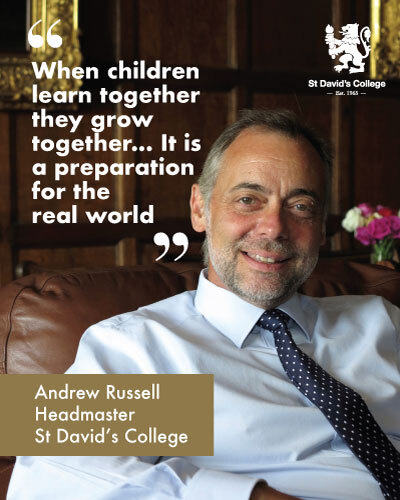
When children learn together, they grow together. They challenge assumptions, develop understanding and build the kind of inclusive leadership our workplaces and communities desperately need.
That isn't simply an educational philosophy.
It is preparation for the real world.