Assume Potential. Change Futures.
There is still a persistent misconception in education that learning differences place a ceiling on achievement.
They do not.
What limits too many young people is not their potential, but an education system that can still be too quick to judge ability by how closely a child fits a conventional model of learning. Intelligence, however, is far more diverse than that. It is expressed in different ways, and it flourishes when it is recognised, understood and properly supported.
My experience has shown me time and again that when pupils are given the right specialist support within an ambitious and nurturing educational environment, they can thrive academically, socially and personally. That is not an abstract ideal. It is what we see every day at St David's College.
St David's is a mainstream school delivering specialist provision for a distinct cohort of pupils whose needs have not been successfully met in previous mainstream settings, despite appropriate SEN or ALN support and intervention. Many of our pupils arrive with damaged confidence. Too often, they have begun to see themselves as less capable simply because they learn differently.
That is why specialist provision matters so deeply. It should never be confused with lower expectations. On the contrary, specialist provision should mean higher expertise, greater understanding and a more precise approach to teaching and learning.
At St David's, our small class sizes - typically between eight and twelve pupils - allow teachers to know pupils properly and tailor their support without diluting academic ambition. Structured literacy and numeracy intervention, assistive technology and specialist teaching are not add-ons here; they are woven into everyday classroom practice. The aim is not dependency, but independence: helping young people understand how they learn best, develop confidence in their strengths and acquire the strategies they need to succeed.
The impact of that approach goes far beyond improved attainment, important though that is. It is often genuinely transformational.
At present, 166 of our 257 pupils are on the ALN/SEN register, and 63 are supported through EHCPs, IDPs or SENA/CEA plans. Our specialist team includes 20 Level 7 teachers and nine Level 5 specialists, meaning that expertise is embedded across the school day, not confined to one department or intervention space.
And the outcomes matter. Our pupils achieve GCSE results averaging 0.83 grades above their baseline predictions, and around 70% progress to university. Just as importantly, they leave us as more confident, self-aware and resilient young people, equipped not only for further study, but for life beyond school.
For neurodiverse learners, academic success and social success are not competing goals. In many cases, they strengthen one another. When a young person begins to feel successful in the classroom, confidence grows. When confidence grows, participation, independence and aspiration often grow with it.
The best schools are not those that create different ceilings for different learners. They are the ones that create environments in which all learners can access high expectations and meaningful opportunity, even if the path towards those outcomes looks different from one child to another.
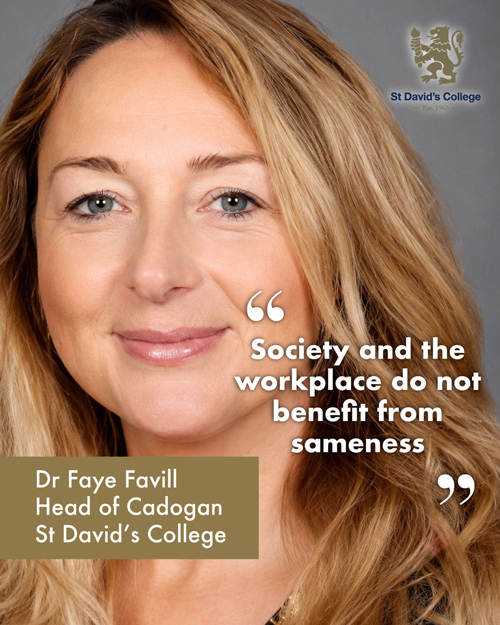
That, after all, reflects the real world. Society and the workplace do not benefit from sameness. They benefit from difference - from varied ways of thinking, problem-solving and seeing the world. Increasingly, the most successful organisations understand that cognitive diversity is a strength. Education should reflect that truth far earlier and far more confidently.
At St David's College, we have spent many years demonstrating that specialist support and academic excellence are not opposing ideals. They are partners. When we assume potential rather than limitation, we do far more than improve outcomes.
We change futures.